Run Claude, Codex, and Gemini across parallel branches. Sandboxed clones, blind cross-model review, and a serialized merge queue in one local Rust binary.
Queue work cards across your repos and step in only when a real decision, visual mock, or review finding needs you. Each task runs in its own Linux sandbox, gets audited by a separate model family with no builder history, and lands serially once checks and tests pass.
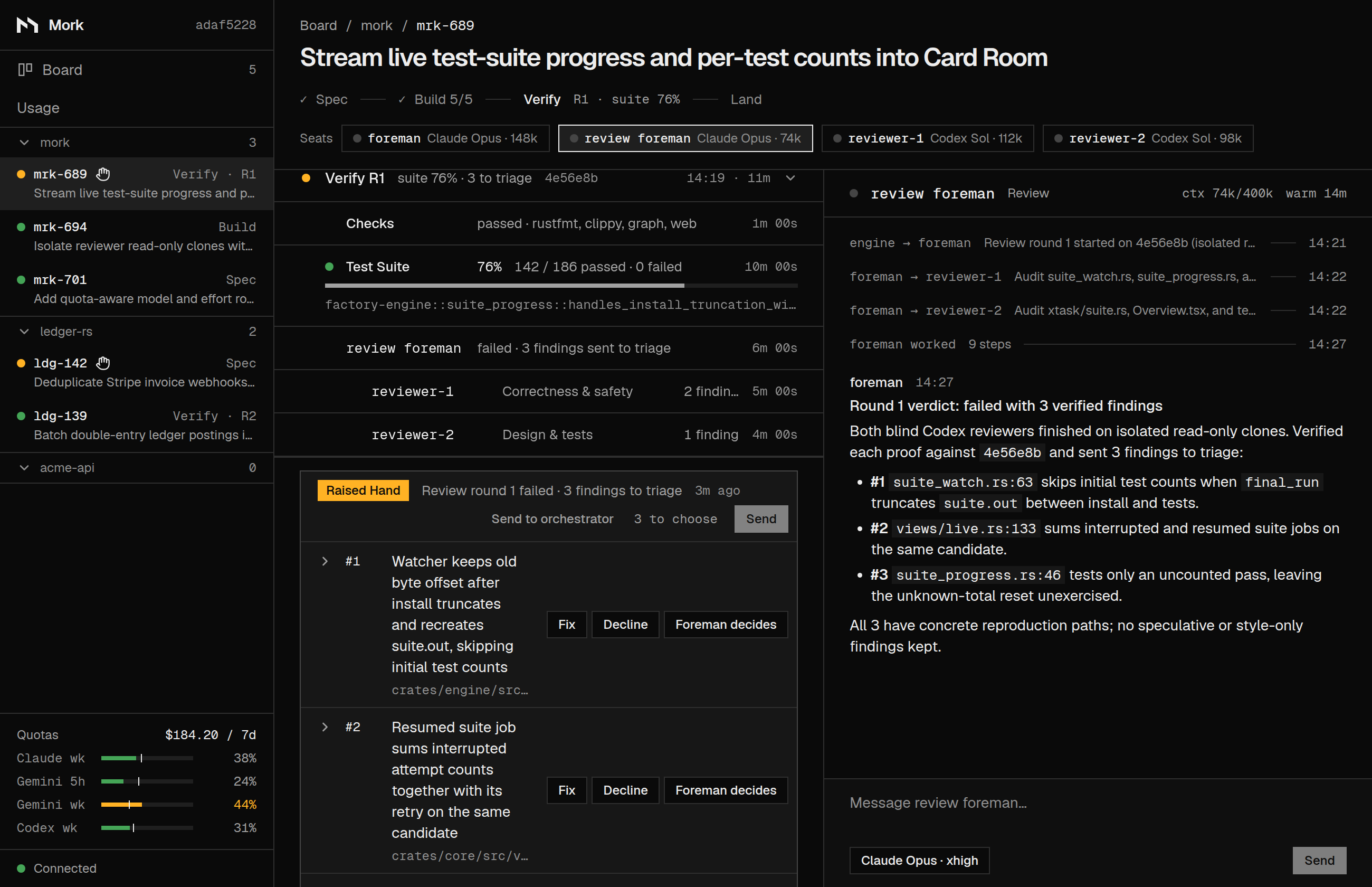
delegation, triage_and_views, lifecycles, and checks (0 findings).
exit_verification so the card sits in Build with its triage ask open. Stopping the card, resolving its findings, then turning delegation on calls dispatch_direct -> send_chosen, which sees zero open findings and returns without queuing a verification restart once resumed.
to_round_failed while the suite is still pending, so each delegated verdict goes through hold_round and leave_for_triage. No test exercises direct dispatch in from_verdict at triage.rs:55-57.
take_ungiven (triage.rs:81) and dispatch_released (triage.rs:92) each have one caller in messages/delegate.rs:43-46. One release_on_delegate(p, c, ctx) function replaces both and removes the pass-through wrapper.
triage.rs:276-281 collects raised.iter().filter(|x| x.resolved).map(|x| x.n), duplicating the exact inline expression in apply_declines at triage.rs:198-199. One shared resolved_of(&Card) helper serves both call sites.
Board, Card Room, and Quota tracking on localhost.
What the engine enforces beyond git worktree and tmux.
Running several CLIs by hand breaks down at the same places: the session that wrote a diff reviews its own code, parallel branches collide on main, and you spend the afternoon polling terminals.
Several branches in flight, one triage queue
Each card runs in its own git clone inside a Bubblewrap + Landlock sandbox. Agents stay quiet while they work and surface a Raised Hand only when a product decision, plan approval, or failed review needs your input.
Review a clickable browser mock before touching production files
On UI cards, Mork opens a live mock in your browser and lets a second model challenge the plan before implementation starts. Layout and flow disagreements get settled while changes are still cheap.
Independent reviewers on a read-only clone
Finished diffs go to a separate model family in a fresh read-only clone with no builder chat history. Every finding requires an exact file:line and reproduction path, and the engine blocks merge until each kept issue is fixed or explicitly declined.
Built around existing CLI plans and a serial landing queue
Mork drives your existing Claude, Codex, and Gemini CLI logins directly with no API proxy or per-credit markup. It tracks weekly quota pace and prompt-cache warmth across providers, and lands approved branches one at a time onto base after re-running checks and tests.
Run-history numbers across 1,049 shipped cards.
Collected from Mork's local SQLite journal across four active repos: Mork itself (460 cards, ~95k LOC Rust and TypeScript), a large legacy Node/Angular production web app, a Rust game rewrite, and a web service. Not a formal benchmark; one maintainer's production history.
Sandbox guard silently dropped in a refactor
A cleanup removed one config branch, letting report tasks run without filesystem restrictions. Every unit test stayed green; an isolated Codex reviewer caught it on Round 1.
Frontend crashed on clean zero-finding rounds
The backend omitted empty arrays during JSON serialization while the UI assumed the key always existed. Cross-model review traced the exact wire contract and blocked the merge.
Retried merges wiped commit history metadata
When a branch rebased and retried, writer attribution was overwritten and permanently lost. Caught cold with a reproduction proof before touching main.
How Mork differs from single CLIs, DIY worktrees, and cloud agents.
Everything runs on your own Linux machine using the CLI subscriptions you already pay for. Source code and local databases stay on your host.
| Setup | What happens in practice | What it costs you |
|---|---|---|
| Single CLI + skills Claude Code / Codex |
One branch at a time. Same session reviews its own work and drifts as context grows. | Your subscriptions + hours spent babysitting and cleaning up diffs. |
| Cross-model review skills cross-review / MCP loops |
Adds a second reviewer, still inside one terminal thread and one working tree. No parallel clones, live UI mocks, Raised Hands triage inbox, merge train, or quota/cache ops. | Free open source + manual branch management and terminal babysitting. |
| Cloud agent platforms Kiro / Factory.ai |
Cloud-hosted loops with vendor lock-in and limited cross-family verification. | Seat fees plus $0.04+/credit usage markups on top of model costs. |
| DIY worktree scripts git worktree + tmux |
Parallel trees, but manual rebase/merge choreography, no cross-model review gate, and no unified triage or quota view. | Free code, plus ongoing script maintenance and manual branch babysitting. |
| Mork mork.sh |
Parallel sandboxed branches, live UI mocks, cold cross-model review, 1-click triage, merge train. | Free & open source · BYO subscriptions · 100% local. |
100% local. Free and open source.
Bring your own Claude, Codex, and Gemini CLI subscriptions with zero API markup or cloud lock-in.
- 100% local: your code and secrets stay on your machine (bubblewrap + Landlock sandboxes)
- Works with your existing Claude, Codex, and Gemini CLI subscriptions
- Parallel branches, live visual mocks, cross-model review, and serialized merge train
- Clean web UI with Raised Hands triage, cache countdowns, and quota tracking
Mork is a self-hosted tool I run every day across four active repos. Inspect the Rust state machine, sandbox walls, review prompts, and React web UI directly.